Blueberry Scorch Virus (BlScV) Identified in Central Washington – What Growers Need to Know
Blueberry scorch virus (BlScV) is an aphid‑vectored virus capable of weakening and eventually killing blueberry plants. Its presence has been confirmed in two independent fields in Benton County, Washington.
Lisa Wasko DeVetter, Washington State University Department of Horticulture, email here
AJ Johnson, Washington State University Clean Plant Center Northwest, email here
Scott Harper, Washington State University Clean Plant Center Northwest, email here
Key Takeaways
BlScV is now confirmed in Central Washington, and early detection is critical for management.
Free testing is available this spring through the Washington Blueberry Commission.
Aphid management is essential to prevent spread within and between fields.
Remove infected plants and monitor fields for several years, focusing especially on areas near where plants were removed. The virus can remain latent for years before symptoms appear.
Blueberry Scorch Virus Overview
Blueberry scorch virus (BlScV) is an aphid‑vectored virus capable of weakening and eventually killing blueberry plants. Its presence has been confirmed in two independent fields in Benton County, Washington. The source and extent of infection, how the virus is moving, and the broader implications for the region are still being investigated. While work to answer these questions continues, this update provides an overview of the virus, its vector, and current management recommendations to help growers prepare for the season ahead.
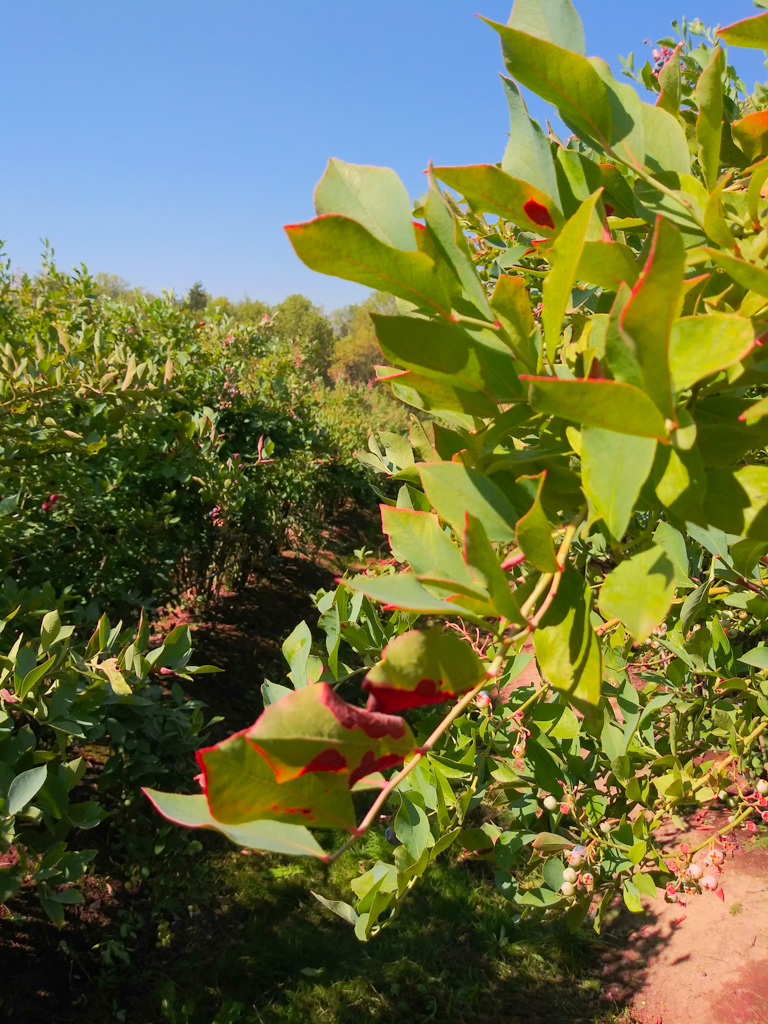
Symptoms of BlScV can differ among cultivars but usually take 1-2 years to develop after initial infection and often start with shoot tip dieback on isolated branches, followed by blighting of blossoms during early to mid‑bloom. These early symptoms can resemble other issues, including blueberry shock virus or frost damage, which makes early detection challenging but especially important. As infection progresses, the entire bush may become affected within 1-3 years, and infected plants typically repeat the same symptom cycle each spring. Fruit production and shoot growth can decline sharply or gradually, depending on cultivar, and some tolerant cultivars may show only marginal leaf yellowing without flower blight.
BlScV is widespread in British Columbia and Northwestern Washington. Furthermore, it has been found in most Washington and Oregon planting regions west of the Cascades. The virus is non-curable and is spread through the planting of infected nursery stock or by specific aphid species. Because no treatment options exist, only plant certified nursery stock that has been tested for BlScV and other viruses. However, since common testing procedures are not always sensitive enough to catch every infection, it’s critical for growers to watch closely for symptoms, use testing protocols regularly, and stay on top of aphid management.
Testing: The Foundation of Management
Virus testing remains the most effective tool for identifying and containing BlScV. This spring, the Washington Blueberry Commission is offering free testing for both BlScV and Blueberry Shock Virus (BlShV), with up to 30 samples available at no cost to each farm paying assessments. Testing is conducted by Phyto Diagnostics, a lab with extensive experience serving growers in British Columbia. Results are confidential and shared only with the grower and the lab.
Growers should begin collecting samples as soon as symptoms appear. Because BlScV and BlShV cannot be reliably distinguished visually, sampling both symptomatic plants and a few nearby asymptomatic plants is recommended. Below are instructions on sample collection:
Collect from plants representative of symptoms in the field.
For each sample, collect 5 live leaves from around a plant, choosing leaves close to symptoms when possible. Leaves should be dry or sampled leaves should be patted dry with paper towels. Place the 5 leaves in a seal-able plastic bag.
Label the plant and the bag, so you can return to the plant once you have results. Use a simple, sequential numbering system for multiple samples. Label each bag with permanent marker on the bottom right corner.
Keep samples dry, but fresh. Keep cool after collection; refrigerate if possible. Do not freeze.
Arrange samples in sequential order, in groups of 10-20. Clip or staple the upper left-hand corner.
Fill out Phyto Diagnostics’ Sample Submission Form, and include it with your samples. Keep a copy for yourself.
Samples can be shipped overnight to Phyto Diagnostics (address: 9381 Ardmore Dr, North Saanich, British Columbia, V8L 5G4, Canada). Pack samples according to the laboratory’s instructions and include two copies of the required Import Permit (the Blueberry Commission will provide this to growers, and additional submission guidance is available from Tom Walters). Samples have no commercial value, and this should be indicated to the shipper; otherwise, Canadian Customs may apply charges to Phyto Diagnostics. The laboratory typically reports results within approximately two weeks of receipt.
Plants that test positive for BlScV should be removed promptly, and fields should be monitored closely for at least 3 years. When purchasing new plants, request documentation confirming they have been tested for BlScV.
A separate publication addressing vector monitoring and management is in preparation and will be released soon.
If you have any questions about the virus testing program, please contact Tom Walters, Walters Ag Research: 360-420-2776, email
Growers in Benton County can also contact Gwen Hoheisel, WSU Extension Regional Specialist, 509-786-5609, email