Chilling Insights for Blueberry in Western Washington
Chill Hours in Western Washington: Are We in Good Shape this Season?
Growers across western Washington have raised concerns about whether we’ve accumulated sufficient chill hours this winter. Chill hours are essential for proper bud development in perennial crops like blueberry, and they accumulate when temperatures are above freezing.
The temperature range that contributes to chill is 32–45°F. When chill requirements are not met, floral and vegetative buds appear to remain dormant longer than expected, and bud break can be uneven or nonexistent. This can reduce yield potential and affect fruit quality. Fortunately, most northern highbush blueberry cultivars grown in the Pacific Northwest have mid‑ to high‑chill requirements with high-chill cultivars typically needing a minimum of 800-1000 chill hours. Even in years when chill accumulation falls below historical averages, these cultivars generally meet their requirements without issue.
Where We Stand This Year
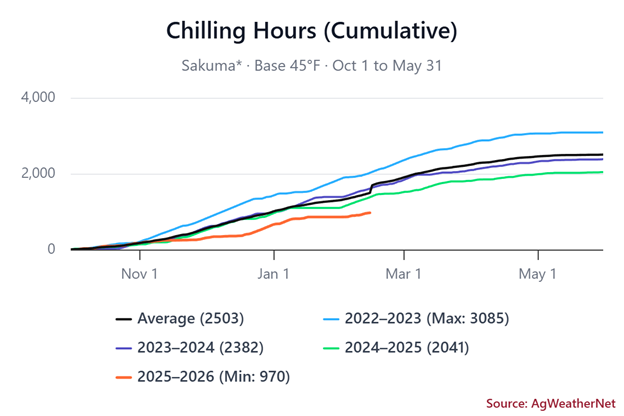
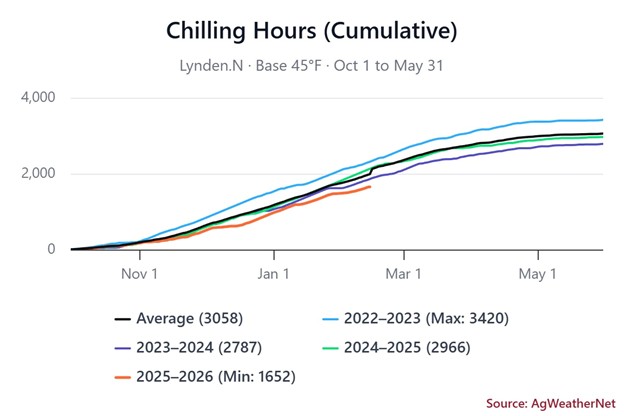
When we look at chill‑hour accumulation across northwest Washington, we are indeed running below our long‑term averages. As of February 14, 2026, the Sakuma station in Skagit County has accumulated an estimated 970 chill hours (Fig. 1), while the Lynden North station in Whatcom County has accumulated 1,652 chill hours (Fig. 2). Both values are several hundred chill hours below historical averages for this point in the season. However – this does not indicate insufficient chill. We are well above the minimum threshold of 800 chill hours required by most commercial northern highbush cultivars and are approaching the 1,000‑hour mark.
Field observations support this assessment. Many fields in Skagit County are already showing bud swell, indicating that chill requirements have been met and that the region is likely heading into an early season. With this visible phenological advancement, the lower‑than‑average chill accumulation is not expected to cause issues such as poor flower or vegetative bud break.
What Growers Can Do
Growers wishing to check chill sufficiency on their farm can do the following:
Take cuttings, place cut ends in water, and force bud break indoors. This simple test will show whether buds are ready to break and grow. Based on current conditions and field observations, it is expected growers will see strong bud break even with this year’s lower chill hour totals.
Monitor chill hours on WSU AgWeatherNet. The platform uses the widely accepted 45°F base temperature and is free to access here.
A Final Note: Watch for Freeze Risk
While chill accumulation appears sufficient, freeze damage is of greater concern at this point in the season, particularly for cultivars with lower chill requirements (e.g., ‘Legacy’ and ‘Roberto’). As buds advance, plants lose cold hardiness, and damage can occur if temperatures drop below critical thresholds. Monitoring weather forecasts and being prepared to protect sensitive cultivars is recommended. Freeze‑damage risk can also be tracked using the Blueberry Cold Hardiness Model available through WSU AgWeatherNet. The model is free to use, although it does require users to register and create a profile and password.
Contact
If you have questions or want help interpreting chill or cold hardiness models, feel free to reach out to Lisa Wasko DeVetter, WSU Small Fruit Horticulture lead, at lisa.devetter@wsu.edu